
Table of Contents
The End of Dollar Dominance? Understanding De-dollarisation, China’s Gold Strategy, and the Push for a New Global Financial Order
For nearly eight decades, the United States dollar has sat at the apex of the global financial system. It has been the world’s primary reserve currency, the default medium for international trade, and a powerful symbol of American economic supremacy. From the oil fields of the Middle East to the factories of East Asia, the dollar’s influence has been near-absolute. But a quiet revolution is now underway. Across the corridors of power in Beijing, Moscow, and beyond, a fundamental question is being asked with increasing urgency: Is it time for the world to move on?
A powerful convergence of forces is now challenging the status quo. Soaring US national debt, the aggressive use of financial sanctions as a foreign policy tool, and the strategic ambitions of rival nations—particularly China—are accelerating a trend known as “de-dollarisation.” This article explores the historical roots of the dollar’s power, the key strategies being deployed to create an alternative financial order, and what a potential new world monetary order could look like for the rest of us.
The Rise of the Dollar: A Brief History
The dollar’s dominance was not an accident of history but the result of deliberate design. Its ascendance began in earnest in 1944, when delegates from 44 Allied nations gathered at Bretton Woods, New Hampshire. In the shadow of World War II, they sought to create a stable postwar economic system. The resulting Bretton Woods Agreement established the US dollar as the world’s new anchor currency, pegging it directly to gold at a fixed rate of $35 per ounce. Other major currencies were then pegged to the dollar.
This system worked as long as the US held the majority of the world’s gold reserves, which it did. However, by the late 1960s, mounting US spending on the Vietnam War and domestic programs led to inflation and a drain on gold reserves. In 1971, President Richard Nixon effectively ended the Bretton Woods system by suspending the dollar’s convertibility into gold—a move that shocked the global economy. The world had moved to a system of fiat currencies, where money’s value is derived from government backing rather than a physical commodity.
Yet, paradoxically, the dollar’s dominance did not end. It was strengthened by a secret agreement with Saudi Arabia in 1974. The US promised military protection to the oil-rich kingdom in exchange for pricing all its oil exports exclusively in dollars. This created the “petrodollar” system. Because every nation needed oil, and oil could only be bought with dollars, the world’s demand for the currency became insatiable. This artificially created demand allowed the US to run massive trade deficits and borrow cheaply, solidifying its financial power for another half-century.
Why Trust in the Dollar is Declining
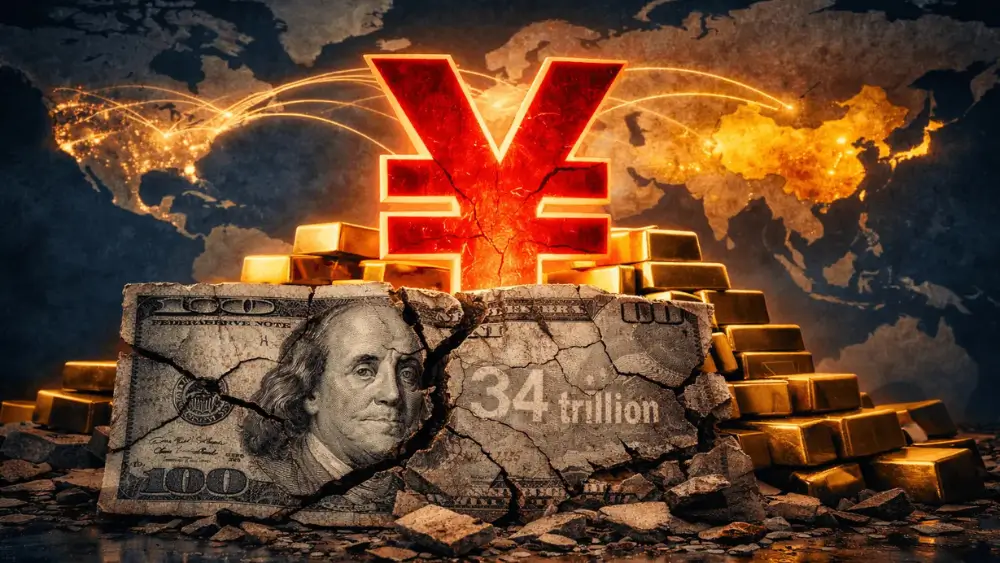
Despite this structural advantage, trust in the dollar’s long-term stability is eroding. The primary driver is the staggering and seemingly unending growth of US national debt, which now exceeds $34 trillion. Economists warn that such debt levels are unsustainable. As the US government borrows more to service its existing obligations, it raises concerns about future inflation and the possibility of a debt default—however remote. For foreign holders of US Treasury bonds, like China and Japan, this represents a growing financial risk.
Simultaneously, the US has increasingly weaponized its financial system. Following the 9/11 attacks, and more aggressively after Russia’s annexation of Crimea in 2014 and its full-scale invasion of Ukraine in 2022, the US and its allies have imposed sweeping sanctions. These include freezing hundreds of billions of dollars in central bank assets and disconnecting key Russian banks from SWIFT, the global financial messaging system. While effective as a punitive measure, this has sent a chilling message to other nations: your dollar reserves are not safe if you fall out of political favor with Washington.
This “weaponization of finance” has accelerated the search for alternatives. Nations like China, Russia, Iran, and others now view excessive reliance on the dollar as a strategic vulnerability. They fear that their access to global trade and their own reserves could be cut off at any moment, effectively holding their economies hostage. This fear is the single greatest catalyst for the de-dollarisation movement.
The Rise of De-dollarisation and the BRICS Factor
De-dollarisation is the process of reducing the world’s dependence on the US dollar in international trade, finance, and central bank reserves. It is not an event but a gradual, multi-decade trend. At the heart of this movement is the BRICS bloc—an acronym for Brazil, Russia, India, China, and South Africa. Recently expanded to include Egypt, Ethiopia, Iran, and the United Arab Emirates, this group represents a significant portion of the world’s population and economic output.
The BRICS nations are actively building the infrastructure for an alternative financial system. They are encouraging trade settlement in their own national currencies. For example, India is paying for Russian oil in rupees and dirhams, while China and Brazil have agreements to trade in their own currencies, bypassing the dollar entirely. These are small but symbolic steps that, if scaled, could significantly reduce demand for dollars.
More ambitiously, there is ongoing discussion within BRICS about creating a new common currency or a stable trading unit. While the idea faces enormous technical and political hurdles—given the diverse economies and geopolitical rivalries within the bloc—its very discussion signals a profound shift. The goal is not necessarily to replace the dollar overnight but to create a parallel system that offers choice and insulation from US influence. For many nations in the Global South, this is an attractive proposition.
China’s Strategic Play: The Yuan and the Gold Link
No nation is pursuing de-dollarisation more systematically than China. As the world’s second-largest economy and largest exporter, China views internationalizing its currency, the Renminbi (or yuan), as a critical step toward achieving great power status and reducing its vulnerability to US sanctions.
China’s strategy is multi-pronged. First, it has established currency swap lines with over 40 countries, allowing them to obtain yuan in exchange for their local currency, facilitating bilateral trade. Second, it has launched the Cross-Border Interbank Payment System (CIPS), a direct alternative to SWIFT that allows for yuan-denominated transactions. While CIPS still handles a fraction of SWIFT’s volume, its use is growing steadily.
Perhaps most significantly, China has been on a historic gold-buying spree. For well over a year, the People’s Bank of China has been adding tens of tons of gold to its reserves almost every month. This is a strategic move with multiple objectives. Gold is a tangible asset with no counterparty risk, unlike US Treasury bonds. By accumulating gold, Beijing is diversifying away from dollar-denominated assets. Furthermore, a large gold reserve provides a foundation of trust for the yuan. Should China ever want to make its currency fully convertible or back a digital version with gold, it would need substantial reserves. This accumulation is laying the groundwork for a potential future where the yuan is seen as a truly stable, global store of value.
The development of the Digital Yuan (e-CNY) is another crucial piece of this puzzle. A central bank digital currency (CBDC) gives the state unprecedented control and visibility over money flows. For international use, a digital yuan could theoretically allow two parties to transact directly, instantly, and without relying on the dollar-centric correspondent banking system. It is a tool designed for a future where financial sovereignty is paramount.
Alternative Visions: Cryptocurrency and a New Reserve Asset
Alongside state-led efforts, decentralized cryptocurrencies have been touted by proponents as the ultimate alternative to fiat currencies like the dollar. Bitcoin, with its fixed supply, is often described as “digital gold”—a hedge against inflation and government mismanagement. In theory, a global, borderless, decentralized currency could be the perfect foundation for a new world order, free from the control of any single nation.
However, the reality is more complex. Cryptocurrencies have proven to be extremely volatile, making them poor stores of value for risk-averse central banks. They also face significant regulatory scrutiny, scalability issues, and energy consumption concerns. While crypto will undoubtedly play a role in the future of finance—particularly in remittances and as an investment asset—it is unlikely to become the world’s primary reserve currency anytime soon.
A more probable outcome is the emergence of a new, diversified reserve system. This could resemble the International Monetary Fund’s Special Drawing Rights (SDRs), which is a basket of major currencies (dollar, euro, yuan, yen, pound). A future system might be multi-polar, with the dollar, euro, and yuan sharing reserve status, possibly backed by a digital gold standard or a new BRICS currency unit. This would be a more complex and potentially less stable system, but it would reflect the new multipolar geopolitical reality.
The Stakes: What a New World Order Means for the Global Economy
A transition away from dollar dominance would have profound consequences. For the United States, the end of its “exorbitant privilege” would mean higher borrowing costs, as the rest of the world would no longer be compelled to buy its debt. This could lead to higher interest rates, slower economic growth, and inflation at home. The ability to impose powerful economic sanctions would also be diminished, reducing a key tool of US foreign policy.
For the global economy, the transition period could be rocky. A fragmented financial system with multiple trading blocs and currencies would increase transaction costs and complexity. Businesses would face greater uncertainty and currency risk. However, proponents argue that a more balanced system could also be more stable in the long run, reducing the risk of contagion from any single economy’s mismanagement.
The concept of “unsustainable economics” is often compared to the laws of physics. You can defy gravity for only so long before a correction occurs. The current dollar-centric system, built on decades of mounting debt and maintained partly through financial coercion, may have reached its limit. The shift is not a matter of “if,” but “when” and “how.”
Conclusion
The world stands at a financial crossroads. The US dollar’s dominance, unquestioned for nearly eighty years, is being actively challenged by a confluence of geopolitical and economic trends. The rise of de-dollarisation, driven by China’s strategic gold accumulation and the BRICS push for an alternative financial architecture, is reshaping the global landscape. Whether a new currency order fully emerges remains to be seen, but one thing is clear: the unipolar financial moment is over. A multipolar world demands a multipolar monetary system, and its outlines are already taking shape before our eyes. The genie is out of the bottle, and it cannot be put back.