
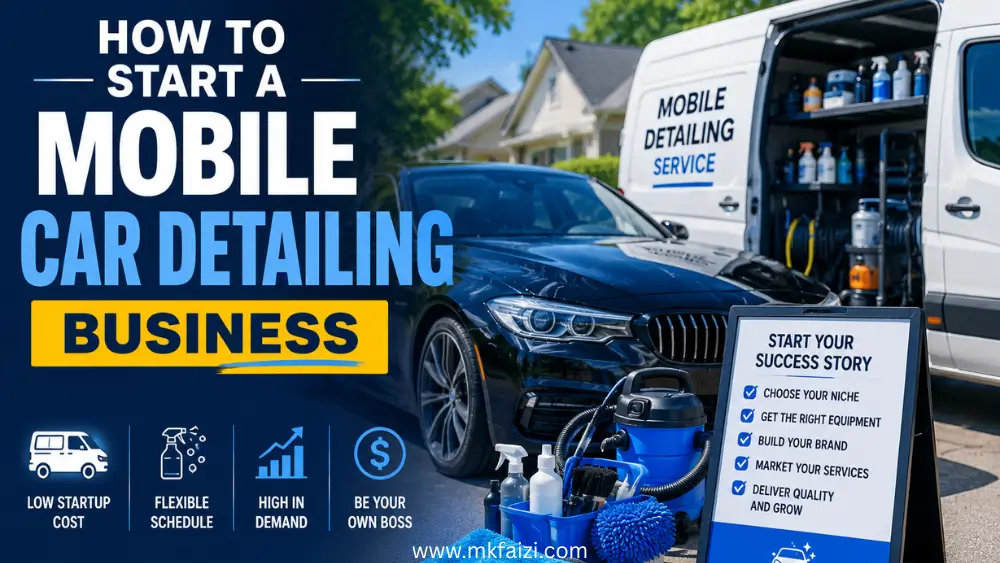
Mobile car detailing is growing at 19.35% annually — nearly four times faster than the overall detailing market. Solo operators routinely earn $90,000–$150,000 a year with no shop, no staff, and no lease. The van pulls up, the work gets done, and the money comes in the same day.
But the guides written about this business have a problem. They put “mobile” in the title and write a generic detailing article. Van layout gets one paragraph. Water systems get a bullet point. Route strategy — the single biggest profit lever in mobile operations — gets nothing at all.
This guide is different. It is written specifically for mobile operators: van selection and interior organization, power and water system options, mobile-specific permits, territory planning, route clustering, and the day-to-day systems that separate a five-figure operation from a $30,000 side gig.
If you want a fixed-location shop guide, this is not it. If you want to start lean, validate fast, and scale by adding vans rather than signing leases — keep reading.
Table of Contents
Mobile vs Shop vs Home-Based: Make the Right Call Before You Spend
Before you buy a single bottle of soap, you need to commit to a business model. The model you choose determines your startup cost, your daily overhead, your profit margins, and how quickly you can recover if the first few months are slow.
The economic case for mobile in 2026
The numbers are not close.
A professional mobile setup — van, equipment, insurance, supplies — costs $5,000–$15,000. A fixed-location shop requires $94,000–$300,000+ before you service your first vehicle. Monthly overhead for a solo mobile operator runs $800–$1,200. A shop’s fixed costs — rent, utilities, insurance, facility maintenance — run $3,000–$5,000 per month before revenue covers them.
Mobile detailers also keep more of what they earn. Without rent and employee costs, gross profit margins run 60–80%. Shop operators, carrying significant fixed overhead, typically see 35–55%.
Scalability also favors mobile. When you outgrow your capacity as a solo operator, you add a second van — not a second lease. The capital required is dramatically lower, and the risk is proportionally smaller.
When a shop makes sense — and it’s not now
There are legitimate reasons to eventually open a fixed location. Multi-stage paint correction requires controlled lighting. Ceramic coating needs a climate-controlled booth. High-volume operations benefit from multiple bays. But these are reasons to open a shop after you have established revenue, a built client base, and the capital to justify the overhead — not reasons to start with one.
The most common failure pattern in new detailing businesses: signing a lease before proving demand. Fixed costs create financial pressure that leads to underpricing, overworking, and eventual closure. Validate the market first. Build the revenue. Then invest in infrastructure.
The decision matrix
| Mobile | Shop | Home-Based | |
|---|---|---|---|
| Startup cost | $5K–$15K | $94K–$300K+ | $500–$3K |
| Monthly overhead | $800–$1,200 | $3,000–$5,000+ | $300–$600 |
| Gross margin | 60–80% | 35–55% | 65–80% |
| Risk level | Low | High | Low–Medium |
| Scale path | Add vans | Add bays | Very limited |
| Best for | Most new operators | Established operators | Early testing only |
Recommendation: Start mobile. Home-based is acceptable for the first 2–3 weeks of validation. A shop is the right investment after you have 3+ months of consistent revenue that justifies the overhead.
Choose and Set Up Your Mobile Detailing Vehicle
Your vehicle is your business. It carries your equipment, presents your brand, and determines where and how efficiently you can work. This decision deserves more thought than most guides give it.
Vehicle options: van vs trailer vs SUV
Cargo van — the recommended choice
A full-size cargo van is the best all-around vehicle for a mobile detailing business. It is self-contained, weatherproof, and professional in appearance. You can park it in most residential driveways, it draws less attention than a trailer rig, and it keeps all your equipment dry and organized regardless of weather.
The most popular models among mobile detailers:
- Ford Transit (High Roof): Most popular choice. Excellent parts availability, stand-up interior height at 72″, 130″ or 148″ wheelbase options, strong payload rating. Used: $14,000–$22,000. New: $42,000–$55,000.
- Ram ProMaster: Widest cargo floor of any full-size van — fits more equipment side by side. Front-wheel drive is a tradeoff in snow. Used: $12,000–$20,000.
- Mercedes Sprinter: Premium option with excellent fuel economy and a large aftermarket. Higher purchase price ($20,000–$30,000 used) and more expensive to maintain. Worth it once you’re generating consistent revenue.
Key specs to evaluate before buying:
- Interior height: 62″ minimum; stand-up height (66″+) is significantly better for a full day of working inside the van
- Payload rating: Target 1,500 lbs or more — water tanks, equipment, and supplies add up fast
- Cargo length: 130″ wheelbase minimum for a functional layout; 148″ gives more breathing room
- Electrical system: Verify compatibility with a secondary battery and inverter before purchase
Detailing trailer
Lower entry cost ($3,000–$8,000 used) but requires a tow vehicle with the appropriate hitch rating, is significantly harder to maneuver in residential driveways and urban parking, and offers less weather protection for chemicals and equipment. Better suited to rural and suburban markets with wide lots and easy access. Not recommended as a first vehicle in city or dense suburban markets.
SUV or pickup truck
A viable starting point for the first 4–6 months while you validate revenue before committing to a van. Storage is limited, there is no weather protection for equipment, and the professional appearance is weaker. Transition to a cargo van once monthly revenue consistently exceeds $3,000–$4,000.
The interior van layout — how to organize your setup
A disorganized van is a slow van. The difference between a detailer who finds every product in 10 seconds and one who hunts for a clay bar for four minutes between panels is real money — at $50+/hour in effective rate, wasted motion costs $3–$5 per minute of lost time.
The rule: every item has a fixed home. You should be able to reach any product in the van without thinking about where it is.
Driver side wall: Install an Adrian Steel, Sortimo, or Ranger Design shelving unit with adjustable shelves. Organize chemicals by category, never by brand:
- Shelf 1 (top): Exterior — car shampoo, foam cannon soap, iron remover, clay bar
- Shelf 2: Paint care — polish compounds, spray sealant, ceramic coating products
- Shelf 3: Interior — APC, leather cleaner/conditioner, fabric protectant, odor eliminator
- Shelf 4 (bottom): Wheel and tire — wheel cleaner, tire shine, trim restorer
Passenger side: Water tank bracket and pump assembly, hose reel mounted at waist height, pressure washer secured with heavy-duty rubber mounts.
Rear doors: Hanging organizer for microfiber towels (separated by color/category), aprons, disposable gloves, and paper documentation. Everything you grab first when you arrive at a job lives here.
Floor: Non-slip rubber diamond-plate matting. Wet/dry vacuum and extractor secured with ratchet straps for transit — unsecured equipment becomes dangerous in a sudden stop.
Invest in van shelving before anything else when setting up your interior. A $400–$800 shelving system pays for itself within weeks in saved time and prevented product damage.
Power supply: generator vs inverter vs shore power
You need power to run your pressure washer, polisher, vacuum, work lighting, and extractor. You have three options — each with different costs, noise levels, and operational constraints.
12V inverter with secondary battery (recommended starting setup)
A 2,000–3,000W pure sine wave inverter wired to a dedicated second battery (typically an AGM deep-cycle battery) gives you silent, fume-free power that recharges automatically while you drive between jobs. It powers a dual-action polisher, LED work light, and small vacuum simultaneously without issue.
Cost to install: $300–$600 including battery, inverter, and wiring. Most competent auto electricians can complete this in 3–4 hours.
Limitation: a 2,000W inverter cannot power a pressure washer (most draw 1,500–2,000W on startup) and a polisher simultaneously. Suitable for most interior and polish work; you still rely on client power or a generator for pressure washing.
Portable generator (best for full power independence)
A Honda EU2200i or Westinghouse iGen2200 (both 2,200W) runs a pressure washer and polisher simultaneously with power to spare. Cost new: $1,000–$1,200. These are inverter-type generators — quieter than conventional generators, but still audible.
Noise is the main operational constraint. Some residential areas and most apartment complexes have noise ordinances that limit or prohibit generator use. Know your territory before making this your primary power solution.
Shore power (client’s electrical outlet)
Free, silent, and widely available at residential jobs — most homes have an outdoor outlet near the driveway. Always carry a 50-foot, 12-gauge outdoor-rated extension cord as your backup.
Dependency is the limitation: no outlet access at office buildings, parking garages, or clients who aren’t home during the job. Treat shore power as a supplement, not your primary system.
Best approach: Start with shore power + an inverter for polish work. Add a generator once consistent revenue justifies the investment and your territory requires full power independence.
Water system setup for mobile operations
Water is the operational constraint that separates mobile from fixed-location detailing. How you solve it determines which markets you can serve.
Option A — Client’s hose (start here)
Cost: $0. Works for 90%+ of residential jobs where the client is home and has outdoor hose access. This is where most new mobile detailers start, and it works well until you want to serve apartments, offices, and garages.
Limitation: you cannot serve clients without outdoor water access. If you want to operate at office buildings or apartment complexes — where your best clustering opportunities are — you need another solution.
Option B — Self-contained water tank
A 65–100 gallon cross-linked polyethylene (XLPE) poly tank mounted in the van with a 12V demand pump feeds a hose reel for complete water independence. You fill the tank at home, at a water refill station, or at a commercial filling point before your route.
Cost: $250–$600 for the tank, $80–$150 for the pump, $60–$100 for the hose reel. Total installation: $400–$850.
Critical calculation before sizing your tank: a 100-gallon tank full of water weighs 835 pounds. Add your equipment, chemicals, and yourself, and you need to verify your van’s payload rating handles the total load before you fill it to capacity. Check the payload sticker on the driver’s door jamb — exceeding it is both unsafe and a commercial insurance issue.
Option C — Rinseless or waterless detailing
No tank, no hose, no water source at all. Rinseless detailing products like Optimum No Rinse (ONR) and Chemical Guys Waterless Car Wash use encapsulating polymers to safely lift and suspend dirt particles, allowing them to be wiped away with a microfiber towel without scratching the paint.
A single $20 bottle of ONR diluted correctly washes 25–30 full vehicles. Your cost per wash: under $1.
More importantly, rinseless detailing opens locations that are simply off-limits to traditional washing:
- Apartment buildings with no outdoor water access
- Office parking garages and covered structures
- High-rise residential buildings with underground parking
- Water-restricted areas in drought-affected cities
- Any client at a location where running water doesn’t exist
These are the highest-density locations for repeat mobile business. Operators who master rinseless techniques access a market their water-dependent competitors literally cannot serve.
Wastewater and environmental compliance
Wash water runoff — even from a residential driveway — contains road chemicals, heavy metals, tire particles, and soap. The EPA’s Clean Water Act prohibits this runoff from entering storm drains. Every mobile detailer is subject to this regulation regardless of where they operate.
Before you start operating, contact your county’s environmental protection office and ask specifically about vehicle washing discharge rules. Requirements vary by state and municipality. At minimum, use portable water containment mats ($150–$400) or absorbent berms to capture runoff on-site. In states like California, Washington, and Oregon, requirements are stricter — research your specific location before your first job.
Mobile Detailing Equipment: What You Need, What You Don’t
Mobile detailing requires everything a fixed-location detailer uses plus the mobile-specific infrastructure to operate independently at any location. Buy what the work requires — skip what sounds impressive but doesn’t earn its keep in a mobile context.
Mobile-specific equipment beyond the standard kit
These items are unique to mobile operations and have no equivalent in a shop setup:
- Portable hose reel (50–100 ft): Keeps water lines neat, tangle-free, and off the ground. A $60–$90 investment that pays back in time saved and professionalism at every job.
- Portable LED work light bar (5,000+ lumens): Essential for interior work in garages, shaded driveways, and any job that runs into the evening. A $40–$80 magnetic-mount LED bar clips to door frames and illuminates the interior fully.
- Collapsible detailing cart or caddy: Keeps your active chemicals off the client’s driveway surface, moves with you around the vehicle, and prevents the constant back-and-forth to the van. $30–$80.
- Cordless wet/dry vacuum (Milwaukee M18 or DeWalt 20V): Cordless is significantly better for mobile work — no cable management, no tripping hazard, no dependency on an outlet inside the vehicle. Cost: $120–$200.
- 12-gauge, 50-foot outdoor extension cord: For shore power jobs. Buy a quality cord rated for outdoor use — cheap extension cords cause voltage drop that damages polishers and vacuums over time.
Full equipment list by budget tier
| Item | Starter ($1,500–$3,000) | Professional ($5,000–$10,000) | Premium ($15,000–$25,000) |
|---|---|---|---|
| DA polisher | Budget DA (~$80) | Griots Garage G9 (~$250) | Rupes LHR 15 Mark III (~$500) |
| Vacuum | Corded shop vac (~$80) | Milwaukee M18 cordless (~$180) | Mytee Lite extractor (~$700) |
| Pressure washer | Sun Joe 1,750 PSI (~$130) | Simpson MegaShot (~$350) | Kranzle 1400 (~$900) |
| Chemicals | Chemical Guys starter kit (~$70) | Full Gtechniq/Gyeon line (~$600) | Pro ceramic coating inventory (~$1,500) |
| Microfiber | Amazon 24-pack (~$25) | Rag Company 50-pack (~$120) | Rag Company bulk wholesale (~$350) |
| Water system | Client’s hose | 65-gal tank + pump (~$500) | 100-gal tank + pump + reel (~$900) |
| Power | Shore power + 50ft cord | 2,000W inverter + battery (~$500) | Generator + inverter system (~$1,500) |
| Van shelving | Freestanding wire shelves (~$80) | Adrian Steel unit (~$400) | Sortimo system (~$900) |
What to skip entirely when starting mobile
- Rotary buffer: High paint-removal aggression and zero forgiveness for beginners. A rotary polisher can burn through clear coat in seconds on a curved panel. Master your dual-action polisher first — most paint correction work that clients will pay for in your first two years is achievable with a DA.
- Ozone machine: Useful for severe odor elimination at $150–$300 as an add-on service, but a $200–$500 tool that only earns money once you’re regularly offering premium interior packages. Add it in month 4–6, not month one.
- Steam cleaner: Valuable for engine bays and interior sanitization but not necessary until you’re selling those specific services. A professional steamer costs $800–$2,000. Wait until client demand justifies it.
Legal Setup, Permits and Insurance for Mobile Operators
Mobile detailing has a specific set of legal requirements that most generic guides completely ignore. Get these right before you take a paying client — not after a problem surfaces.
Business structure: LLC from day one
Form an LLC before your first paying job with a stranger. An LLC separates your personal assets from your business liabilities. If a client’s $65,000 Range Rover gets a scratch during a detail and they pursue legal action, an LLC means your personal bank account, home, and savings are protected. A sole proprietorship provides no such separation.
File at your state’s Secretary of State website. Cost: $50–$150, depending on the state. Processing time: 1–2 weeks in most states, same-day in some. Once your LLC is approved, get your EIN (Employer Identification Number) at IRS.gov — it’s free, takes five minutes, and is required to open a business bank account.
Open a dedicated business checking account immediately after receiving your EIN. Mixing personal and business finances is the fastest way to lose track of your profitability and create problems at tax time.
Mobile-specific permits you may need
This is the section most guides skip entirely — and the one that catches new mobile operators off guard.
General business license: Required by virtually every city and county. Apply at your local city hall or county clerk’s office. Annual cost: $25–$100. This is non-negotiable and often the first thing an inspector will ask for if they observe you working in a public or commercial area.
Mobile vendor permit: Some municipalities require a separate permit specifically for mobile service businesses operating within city limits — distinct from a general business license. Call your city’s business licensing department and ask specifically: “Do you require a mobile vendor permit for a mobile car detailing business?” The answer varies significantly by city.
EPA wastewater and stormwater permit: Covered in Section 2, but worth emphasizing here: operating without this understanding is a regulatory risk, not just an environmental one. Fines for illegal stormwater discharge can reach thousands of dollars per incident in some jurisdictions. Contact your local environmental protection or stormwater management office before your first job.
Commercial vehicle parking and zoning: If you park your work van at your home address overnight and depart from there each day, check whether your residential zone permits commercial vehicle overnight parking. Many areas restrict vehicles with commercial lettering or ladder racks in residential zones. Some HOAs have additional rules. A call to your city’s planning department takes 10 minutes and can save a significant headache.
State-specific chemical compliance: If you operate in California, Washington, Oregon, or several other states with stricter environmental regulations, specific chemicals in your inventory may be subject to Proposition 65 warnings, VOC content limits, or disposal requirements. Check your state environmental agency’s website for vehicle washing and chemical use regulations before building your inventory.
Insurance: four policies every mobile detailer needs
General liability insurance ($1M per occurrence / $2M aggregate): Covers bodily injury and third-party property damage claims. If a client trips over your hose and breaks their wrist, this policy responds. Annual cost for a solo mobile operator: $400–$900. Providers: NEXT Insurance, Hiscox, The Hanover, State Farm Business.
Garage Keeper’s Liability: This is the policy most new detailers miss — and the most critical one for your specific work. General liability does NOT cover damage to a customer’s vehicle while it is in your care, custody, or control. Garage Keeper’s Liability fills that gap. Without it, a scratched panel on a client’s vehicle is an out-of-pocket expense that could exceed everything you’ve earned in a month. Non-negotiable.
Commercial auto insurance: The moment you use any vehicle for business purposes — driving to client locations, transporting equipment — your personal auto insurance policy is void for claims arising from business use. Commercial auto is legally required and practically essential. Annual cost: $900–$2,500 depending on vehicle, driving history, and coverage level.
Workers’ compensation: Required in most states the moment you bring on any helper — even a part-time, occasionally paid assistant. The threshold and requirements vary by state. Check your state’s workers’ compensation board before anyone other than you works a job under your business name.
Total estimated annual insurance cost for a solo mobile operator: $1,800–$3,500.
Service Menu, Pricing and Packages for Mobile Detailers
Mobile detailing pricing has layers that generic guides ignore: travel fees, condition surcharges, vehicle size multipliers, and the apartment or garage premium for self-contained jobs. Price without these adjustments and you’ll consistently undercharge.
The 3-tier mobile package structure
Keep your menu simple at launch. Too many options slow down the booking conversation and confuse clients who don’t know what they need. Three tiers handle 80% of inquiries cleanly.
Tier 1 — Basic Wash and Shine ($80–$120) Hand wash and dry, wheel and tire clean, tire dressing, exterior windows, quick interior vacuum and wipe. Time: 1–1.5 hours. Best for: maintenance plan clients who want regular upkeep between full details.
Tier 2 — Interior Refresh ($130–$180) Full vacuum of all surfaces, carpet and upholstery shampoo, leather clean and condition, dashboard and trim clean and protect, interior windows, odor treatment. Time: 2.5–3.5 hours. Best for: families with kids and pet hair; the highest-frequency booking from repeat clients.
Tier 3 — Full Detail ($220–$400) Everything in Tier 1 and Tier 2 plus clay bar treatment, machine polish with DA polisher, spray sealant or paste wax. Time: 5–7 hours. Best for: luxury and performance vehicles; clients preparing for sale; quarterly detail clients on a maintenance plan.
Mobile-specific pricing adjustments
These adjustments are where mobile detailers leave the most money on the table. Build them into every quote from the start.
Travel fee: Include up to a 10–15 mile radius from your operating base in your standard pricing. Beyond that, add a flat $10–$25 travel fee, or factor $0.67/mile (current IRS reimbursement rate) into the quote. Your time in transit is not free — at $50+/hour effective rate, a 30-minute round trip costs $25 that unpriced travel fees absorb directly from your profit.
Vehicle size multipliers: Your base prices apply to a standard sedan or coupe. Adjust upward:
- SUV and crossover: +20%
- Full-size truck or full-size van: +30–35%
- Oversized vehicle, RV, or commercial van: quote individually
Condition surcharge ($40–$75 added to any package): Heavily soiled interiors — active pet hair infestation, smoke damage, mold, food embedded in carpet — take significantly longer than a standard detail. Photograph the condition before you start, inform the client before beginning, and add the surcharge. Most clients expect it if the vehicle is genuinely bad.
Self-contained water and power premium: If a client is at an apartment, office garage, or other location where you must use your own tank, generator, and supplies without access to any of their utilities — factor that operational cost into the quote. This premium is $15–$30 and is entirely reasonable to communicate: “Since I’ll be fully self-contained at this location, there’s a small equipment surcharge — I bring everything needed.”
Mobile maintenance plans: your recurring revenue engine
The most financially stable mobile detailing businesses are not living job to job. They have a base of recurring plan clients who pay automatically each month before a single new booking is made.
Monthly exterior refresh plan: Wash, tire dress, quick vacuum and windows — $80–$100 per month. Easy to sell to busy professionals who don’t want to think about their car. Stacks efficiently when you have 3–4 plan clients in the same neighborhood on the same day.
Quarterly full detail plan: Full Tier 3 detail every three months — $200–$280 per quarter, billed upfront. Often sold in combination with a monthly exterior plan as a complete package.
The math: five maintenance plan clients at $100/month generates $500 in predictable revenue before you book a single one-off job. Ten plan clients at $100/month covers your entire monthly overhead. Build this base aggressively from month two. Pitch it at the end of every full detail: “Most of my regular clients do a monthly refresh to keep it at this level — it’s $90/month and I come to you on the same day each month. Want me to add you to the schedule?”
Route Strategy and Territory Planning
Route efficiency is the single most underestimated profit lever in mobile detailing. Most new operators accept jobs wherever they appear on the map and drive whatever route comes naturally. The difference in earnings between a scattered route and a clustered one is not marginal — it is significant.
Why route efficiency is your hidden profit lever
Consider two detailers doing three jobs per day. Detailer A takes jobs wherever they come: one in the north end, one across town, one near home. Total daily drive time: 90 minutes. Detailer B clusters jobs within a three-mile radius: one neighborhood, three driveways. Total daily drive time: 20 minutes.
The difference: 70 minutes per working day. At an effective rate of $50/hour, that is $58 in lost earnings per day — or $58 recovered, depending on which detailer you are. Over 240 working days: $13,920 per year, from route optimization alone. No new clients. No price increase. No additional equipment.
Set a maximum drive radius per day — 15–20 miles from a central starting point. Build your marketing around that geography. When outlier bookings appear 35 miles away, either charge a travel premium that compensates for the lost time or decline and stay within your profitable zone.
How to cluster your jobs geographically
The goal is to have multiple clients in the same neighborhood, the same office complex, or the same apartment building — ideally on the same day.
Start with one neighborhood. When you launch, pick one target zip code or neighborhood and concentrate your early marketing there: Facebook Group posts, Nextdoor listings, door hangers at car meets. Get 3–5 clients in that area before you expand to the next zone. A single block with four recurring clients means a zero-drive morning with $400–$600 in revenue.
Sequence jobs to minimize backtracking. Use Google Maps route planning (free) to order your jobs: start with the farthest job from your base and work your way back. This avoids the common inefficiency of going far, coming back near base, then going far again.
Use booking software to see your schedule geographically. Once you’re at 15+ jobs per week, Housecall Pro ($49–$129/month) and Jobber ($29–$99/month) both offer route optimization that sequences your daily jobs by location automatically. At that volume, the software pays for itself in the first week.
High-value territory types to target
Affluent residential suburbs: Highest willingness to pay per job. Long driveways offer unobstructed working space. Vehicles tend to be newer and higher-value — owners care more about their appearance. Ideal for full details, ceramic coating add-ons, and recurring maintenance plans.
Corporate office parks: Among the most operationally efficient locations in mobile detailing. Three to six vehicles per stop, clients in meetings all day, no supervision — you work undisturbed for hours. One office park relationship, established with a property manager or office admin, can represent $500–$1,500 per weekly visit. Approach the office manager or facilities coordinator directly. Offer a trial day with a discounted rate on two vehicles.
Apartment complexes with rinseless method: Residents in apartments are among the most underserved mobile detailing clients — they have no hose, no driveway, often no car wash nearby they can conveniently use. Contact the property manager and offer to run a monthly resident detail day in the parking lot. In exchange for access and a mention in the resident newsletter, offer residents a first-booking discount. One complex with 200 units can generate a full day of bookings per month from repeat residents.
Car dealerships: New inventory arriving weekly, used vehicles being prepared for sale, demo fleet maintained — dealerships have a constant, predictable need for detailing. A single dealership account can represent $2,000–$6,000 per month in scheduled, repeating work. To win one, visit in person and ask specifically for the used car manager. Offer to detail one used vehicle at a reduced rate as a trial. A polished used car sells faster — dealers understand this math.
Weather planning for mobile operators
Weather is the operational variable that shops don’t manage and mobile operators must. Build your policies before you need them, not during the problem.
Rain days: Rain does not have to mean zero revenue. Interior-only bookings — full interior details, steam cleaning, leather conditioning — are completely unaffected by rain. Proactively block one or two rain-day slots in your schedule each week for interior-focused work. When weather forces an exterior cancellation, you have a revenue-preserving alternative to offer.
Summer heat: Direct sunlight heats a car’s painted surface far above ambient temperature — often 130–160°F on a black panel in July. Applying products to a hot surface causes them to flash-dry, streak, and bond unevenly. Start jobs before 9:00 a.m. in peak summer. Schedule paint correction and coating work in shaded driveways or garages when possible.
Winter cold: Chemical performance drops below 40°F. Spray sealants, tire dressings, and interior protectants lose viscosity and application consistency. Communicate realistic expectations to winter clients — results may be slightly different from warm-weather details. Offer interior-only packages as your primary winter service in cold climates.
Cancellation policy: Build a 48-hour cancellation policy into every booking confirmation. Weather-driven reschedules are expected — but last-minute no-shows with no policy in place cost you a full day’s revenue with zero recourse. State your policy clearly when confirming every appointment and require a deposit on large jobs.
Mobile-Specific Marketing: How to Fill Your Calendar
Mobile detailing marketing has channels and tactics that simply do not apply to fixed-location businesses. The highest-return approaches are free, local, and community-specific.
Google Business Profile: your most powerful free tool
Set up your profile at business.google.com and configure it as a service area business — not a fixed address. Enter the zip codes or city radius you serve. This is how you appear in Google Maps searches for “mobile detailing near me” without a shop address.
Critical setup details:
- Primary category: “Car detailing service”
- Add secondary category: “Mobile detailing service” or “Auto detailing shop”
- Upload 10+ before/after photos at launch — profiles with photos receive 7x more clicks than profiles without
- Complete your service menu with descriptions and pricing ranges
- Post a photo or update at least once per week — Google rewards actively maintained profiles with higher map pack placement
After every job, text the client a direct link to your Google review page and ask for a review. Not an email. A text. This is the single highest-leverage activity in your first six months. Target 50 reviews within six months — approximately two per week — and your profile becomes a self-generating booking machine.
Neighborhood and community marketing
The most efficient mobile detailing marketing is hyper-local because your ideal clients are geographically concentrated.
Nextdoor: Post in the Services category immediately. After completing a job in a neighborhood, post a brief follow-up: “Just finished this [vehicle type] on [Street Name] — still have openings this week in [Neighborhood].” Nextdoor users trust local service providers more than any other platform because of the verified address requirement. One five-star Nextdoor review from a neighbor generates referrals at a rate most paid advertising cannot match.
Car shows and enthusiast meets: Car enthusiasts are your highest-value client segment — they care deeply about their vehicle’s appearance, have disposable income, and refer aggressively within their community. Attend local car meets and hand a simple card with your Instagram handle and booking link to owners of vehicles worth detailing. You are not selling at the meet — you are making contact with people who will eventually call you.
Apartment complex partnerships: Email or call the property manager. Your message, written in two sentences: “I run a mobile detailing service and would love to offer [Complex Name] residents a discounted detail day once a month in the parking lot. I handle all the booking and payment — all I need is access and a mention in your resident newsletter.” Most property managers say yes because it costs them nothing and provides a resident amenity. One complex partnership can fill an entire day each month.
Office building relationships: Contact the facilities coordinator or office manager at professional office buildings within your territory. Offer a recurring day — every Thursday, for example — where employees can pre-book a detail in the parking lot during work hours. You batch 4–6 jobs per visit. Employees love it because their car is done while they work. You love it because you spend zero time driving between jobs.
Before/after content on TikTok and Instagram
Detailing transformation content has among the highest organic reach of any trade niche on both platforms. A 15–30 second timelapse of a genuinely filthy interior becoming spotless is one of the most watchable categories of content on TikTok — and the views translate directly to booking inquiries.
Post a minimum of three times per week. Every post should include your city name and neighborhood in the caption. Use hashtags that combine your service type and location: #mobiledetailing, #[yourcity]detailing, #mobilecleaning. Respond to every comment and DM within one hour — the first person to respond to an inquiry usually gets the booking.
One video that earns significant traction can generate enough inquiries to fill two to three weeks of bookings. The investment is a phone and a willingness to document your work consistently.
B2B accounts: the most underutilized mobile revenue stream
Individual consumers generate one-off and recurring bookings. B2B accounts generate scheduled, predictable, high-volume revenue that transforms your business math.
Target businesses with vehicles that need regular attention: car dealerships, car rental companies, real estate agencies, landscaping companies, plumbing and HVAC contractors. These clients care about reliability and professional appearance more than price.
The approach: visit in person. Call ahead to ask for the used car manager, fleet manager, or operations director. Bring a one-page rate sheet. Offer to detail one vehicle at a discounted rate as a trial. A dealership that sees a used car sell faster after your detail will call you the following week without prompting.
One dealership contract at $3,000/month changes your entire operation: predictable weekly revenue, no marketing cost per job, efficient scheduled work at a single location. Pursue one dealership relationship as a priority in your first 90 days.
Mobile Operations: Day-to-Day Systems That Save Time and Money
Great detailing work with poor operational systems produces a stressed operator who earns less than their skill is worth. These systems are what keep your schedule full, your clients satisfied, and your business growing without burning you out.
The mobile detailer’s daily routine
The night before: Restock chemicals to full inventory, refill your water tank if running a self-contained system, charge all cordless tools, review tomorrow’s route in sequence, send appointment confirmations to every booking, log today’s mileage ($0.67/mile is deductible — track it daily, not monthly).
Morning: Leave your base with a full kit and arrive at your first job by 8:00–8:30 a.m. in summer (before surface temperatures spike), 8:30–9:00 a.m. in cooler months. You are a morning business — most residential clients prefer morning appointments when their car sits unused.
Between jobs: Send the invoice and a review request link immediately after completing each job. Refill any depleted supplies from your van stock. Navigate via optimized route to the next job. You should have a maximum of 10–15 minutes of transition time between well-clustered jobs.
End of day: Wash all microfiber towels — paint towels in one load, interior towels in another, wheel and tire towels separately. Never mix them in the wash. Restock the van for tomorrow using a standard checklist so nothing is missing at 8 a.m. Log your mileage and any job notes in Wave or QuickBooks.
Booking, invoicing and payment tools
Online booking with required deposits: A client who has paid a 25–50% deposit on a paint correction or ceramic coating appointment is dramatically less likely to no-show. Deposits also demonstrate professionalism and are standard for any premium service. Housecall Pro, Jobber, and Square Appointments all support deposit collection at booking.
Invoicing: Send an invoice immediately after each job via Wave (free) or QuickBooks Simple Start ($15/month). Do not wait until the end of the week — invoice at the job and collect payment before you pack up.
Payment options: Accept every method your clients might use. Square card reader (free hardware, ~2.6% per swipe), Venmo, Zelle, Apple Pay, cash. Clients who can’t pay the way they prefer sometimes don’t pay at all — or choose a competitor who accepts their preferred method next time.
The pre-job vehicle inspection habit
This is the single habit that eliminates the most common and most damaging dispute in mobile detailing: “You scratched my car.”
Before you touch any vehicle, photograph every panel from all four sides, the hood, roof, and rear — and the full interior. Do this systematically, every single job, without exception. Take clear photos that show any existing scratch, dent, paint chip, or interior stain.
Immediately send those photos to the client via text message: “Just doing a quick condition check before I start — got your car documented. Everything looks good on my end, talk soon.”
This serves two purposes. First, it protects you legally — you now have timestamped photographic evidence of the vehicle’s condition before you touched it. Second, it signals to the client that you are a professional who takes their vehicle seriously. Most clients respond positively.
A single disputed scratch claim without documentation can cost you more than a month’s income in repairs, refunds, and reputation damage. Pre-job photos take four minutes. Do it every time.
Scale Your Mobile Detailing Business: From 1 Van to a Fleet
Mobile detailing scales differently than most businesses. You don’t need to sign a bigger lease or hire a large team to double your revenue. You add a van. You add one employee. You repeat the system that already works.
Revenue milestones for a mobile operation
$3,000–$5,000 per month: Solo, standard services, 20–30 jobs per month. Focus at this stage is on pricing correctly, building Google reviews, and developing your first maintenance plan clients. Do not add services or hire anyone yet. Optimize what you have.
$6,000–$9,000 per month: Add paint correction and ceramic coating to your menu. Get IDA-certified or complete a manufacturer’s certification program — this unlocks $500–$2,000 per job services that dramatically increase your average ticket. Add 5–8 maintenance plan clients for baseline recurring revenue.
$10,000–$15,000 per month: You have 1–2 B2B accounts, a core of maintenance plan clients, and a consistently full one-off booking schedule. You are approaching the ceiling of what a solo operator can physically do. This is when you start thinking seriously about a second operator.
$15,000–$30,000+ per month: Second van, first employee or subcontractor, territory expansion. At this level, your business has the systems, reputation, and revenue to support another operator working under your brand.
Adding a second van: what to get right first
Only hire when you’re consistently turning away work. If you’re declining 20%+ of weekly inquiries because you’re fully booked, you have validated demand for a second operator. If you’re occasionally slow and want to grow by hiring — you are not ready. Hiring creates fixed costs that undermine a business that hasn’t yet maximized its solo capacity.
Document everything before handing it to anyone else. Your job checklist, chemical protocols, customer communication scripts, review request procedure, van restock routine — all of it written down before van two goes live. Your new operator runs your system, not their own version of it.
Fund van two from reserve. Ideally, van two is purchased from three months of reserved operating revenue — not financed under pressure. A slow week with a loan payment due forces decisions that compromise quality and client relationships.
When to open a fixed location
Signals that a shop is genuinely the right next step:
- Client demand for ceramic coating and multi-stage paint correction exceeds what you can deliver in driveways
- You need a climate-controlled environment with controlled lighting for high-end paint work
- Revenue from premium paint services is consistent enough to justify $3,000–$5,000/month in fixed overhead
The hybrid model works for many operators: keep mobile for standard details and maintenance plans, use a modest shop space for high-ticket paint correction and ceramic coating only. This protects the margin structure that made the business profitable while unlocking the premium services a shop enables.
Mobile Detailing Business Launch Checklist
Vehicle and setup
- Choose and purchase or lease your detailing vehicle
- Install interior shelving and organize by chemical category
- Set up power system (inverter, generator, or shore power cord)
- Install water system (tank + pump, or confirm rinseless method)
- Acquire wastewater containment mat or berms
Legal and insurance
- File LLC with your state’s Secretary of State
- Obtain EIN from IRS.gov (free, 5 minutes)
- Open dedicated business bank account
- Apply for general business license (city/county clerk)
- Research and apply for mobile vendor permit if required
- Contact local environmental office re: wastewater discharge rules
- Purchase general liability + Garage Keeper’s Liability insurance
- Purchase commercial auto insurance on your detailing vehicle
Equipment and supplies
- Purchase equipment kit appropriate to your budget tier
- Separate microfibers by color: paint / glass / interior / wheels
- Stock minimum 6-week chemical inventory
- Assemble pre-job inspection photo kit (checklist + photo habit)
Business infrastructure
- Set up Google Business Profile as service area business
- Create Square Appointments free account (booking + reminders)
- Set up Wave account (free invoicing and expense tracking)
- Create Instagram and TikTok business accounts
- List on Thumbtack and Yelp (both free)
First clients
- Complete 2–3 free or discounted practice jobs — document everything
- Post launch announcement in 3–5 local Facebook Groups
- Create Nextdoor Services listing
- Text personal network with booking offer and before/after photos
- Target one office park or apartment complex partnership in week 2
- After every job: send review request link via text immediately
FAQs
How much does it cost to start a mobile car detailing business?
A professional mobile setup — van, equipment, supplies, and insurance — costs $5,000–$15,000. A bare-minimum solo start using a personal vehicle and starter-grade supplies can be done for $1,500–$3,000. A multi-van professional operation with full inventory runs $25,000–$50,000.
Do mobile detailers need to bring their own water?
Not always. Most residential clients have a garden hose you can use. For full location independence — apartments, offices, parking garages — a 65–100 gallon self-contained tank ($400–$850 installed) is the solution. Rinseless detailing products allow water-free washing for roughly $0.75 per vehicle, opening locations where no water access exists.
What vehicle is best for a mobile detailing business?
A Ford Transit high-roof cargo van is the most popular choice: stand-up interior height, strong payload, excellent parts availability, and professional appearance. The Ram ProMaster is a close second with the widest cargo floor. Start with a used Transit or ProMaster ($12,000–$22,000) and upgrade once revenue justifies it.
How many cars can a mobile detailer do in a day?
Two to four jobs per day, depending on service type and route efficiency. A day of basic exterior washes: 4–5 jobs. A day of full interior and exterior details: 2–3 jobs. Paint correction or ceramic coating: 1 job per day. Route clustering — working within a tight geographic area — increases daily capacity by reducing transit time between jobs.
Do you need a special license to run a mobile detailing business?
A general business license is required in virtually every jurisdiction ($25–$100/year). Some cities additionally require a mobile vendor permit for mobile service businesses. An EPA wastewater compliance understanding is essential — contact your local environmental office before operating. No detailing-specific certification is legally required, though IDA certification is recommended before offering ceramic coating.
How do mobile detailers deal with bad weather?
Build a rain policy into your operation: offer interior-only bookings on wet days and keep those slots in your weekly schedule. In summer heat, start jobs by 8:00–8:30 a.m. before surface temperatures exceed safe application thresholds. Require a 48-hour cancellation policy on all bookings and collect deposits on large jobs to protect against weather-driven last-minute cancellations.
How much can you make with a mobile detailing business?
A solo mobile operator completing 3 jobs per day at a $150 average, 240 working days per year, earns approximately $108,000 in gross revenue. With 60–80% gross margins and $800–$1,200 in monthly overhead, net earnings run $70,000–$95,000 annually at that pace. Operators adding premium services like ceramic coating ($500–$2,000 per job) and B2B accounts routinely exceed $150,000.