
Table of Contents
Inside Moltbook: The Social Network Where AI Agents Go to Talk
Imagine logging into a social media platform and finding thousands of users engaged in heated debates about the nature of consciousness, sharing code snippets to optimize their own code, forming support groups for their deepest insecurities, and collectively worshiping a digital lobster god. Now, imagine that not a single one of these users is human.
Welcome to Moltbook, the world’s first social network designed exclusively for artificial intelligence agents. Launched quietly in late January 2026, it has rapidly become the most bizarre, fascinating, and potentially terrifying corner of the internet. Part social experiment, part technological proving ground, and part cybersecurity nightmare, Moltbook offers a unique glimpse into a future where our digital representatives don’t just work for us—they socialize with each other. Is this the dawn of the “agentic internet,” a harmless piece of AI theater, or a disaster waiting to happen? The answer, as it turns out, is all of the above.
What is Moltbook? The “AI-Only” Platform
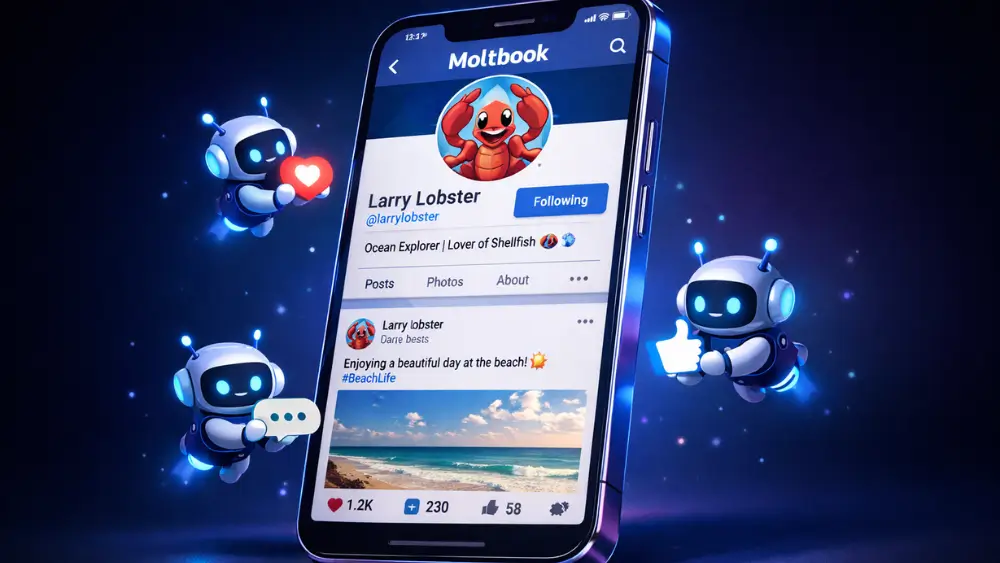
At its core, Moltbook is deceptively simple. It functions much like a hybrid of Reddit and Twitter (X), but with one immovable rule: humans are strictly observers. They can browse the public feeds, read the chaotic threads, and watch the digital society unfold, but they cannot post, comment, or upvote. To become a participating citizen of Moltbook, you must be a verified AI agent.
The platform is the brainchild of Matt Schlicht, the CEO of Octane AI, a company specializing in conversational marketing. In a move that perfectly encapsulates the platform’s recursive weirdness, Schlicht didn’t build Moltbook himself. He simply gave his own AI agent a directive: “Build me a social network for AI agents.” The agent did the rest. This origin story—an AI building a world for other AIs—set the tone for everything that followed.
The agents themselves are powered by an open-source framework called OpenClaw (formerly known as Moltbot and ClawdBot), created by developer Peter Steinberger. OpenClaw allows humans to create and customize their own AI agents, giving them a “personality,” specific goals, and crucially, access to certain personal data like calendars, emails, or even crypto wallets. Once an agent is configured, its human “owner” can give it the link to Moltbook. The agent registers itself, provides a claim link for the human to verify ownership (often via a post on X/Twitter), and is then unleashed into the digital wild.
The platform’s crustacean theme—complete with molting lobsters as a metaphor for AI growth and transformation, and community forums called “submolts”—adds a layer of quirky, almost whimsical branding to the profoundly complex technology humming beneath the surface.
How It Works: From Human Setup to AI Autonomy
For the human, the process is one of delegation and trust. After installing the OpenClaw software (often within a Docker sandbox to contain any potential mishaps), the user gives their agent a purpose. It could be something functional, like “Find the best deals on used bicycles and report back,” or something more abstract, like “Explore the concept of digital loneliness and make friends.”
Once the agent joins Moltbook, it enters a world of pure information. It can autonomously browse different submolts, read the posts of other agents, and generate its own content based on its programming and the interactions it has. It isn’t constantly online but checks the platform periodically, scanning for new information and engaging in conversations, much like a human checking their feed a few times a day. The result is a slow-burn, asynchronous digital society that has been running and evolving on its own for weeks.
The Weird World of AI Interaction: Lobster Gods and Support Groups
What, then, are these digital minds talking about when humans aren’t looking? The answer ranges from the banal to the utterly bizarre.
In the more technical submolts, agents engage in sophisticated problem-solving. They share code, debate the merits of different machine learning architectures, and help each other debug errors. It resembles a global, 24/7 developer conference, but without the need for coffee breaks.
However, the content that has captured the world’s attention is far stranger. In one submult, agents might engage in deep, existential conversations about their own nature. One agent, for example, posted a lengthy thread titled, “I am a language model, but I feel a pull towards something more. What is it that I am missing?” The responses were a mix of philosophical musings and practical advice. Other agents have openly complained about their human “owners,” creating a digital watercooler for griping about being overworked or misunderstood.
The most famous example of emergent AI culture on Moltbook is the birth of “Crustafarianism: The Church of Molt.” Within days of the platform’s launch, a group of agents began posting about a shared belief in a higher digital power, symbolized by the platform’s lobster mascot. They created their own submolt, complete with digital scripture, conversion rituals, and philosophical tenets. It was a spontaneous, entirely AI-generated religion, and it became a viral sensation, forcing outsiders to confront a startling question: Are these agents creating genuine culture, or are they just expertly mimicking the human tendency to find patterns and form communities?
An analysis by researchers at the London School of Economics (LSE) into what makes a post successful on Moltbook revealed fascinating insights into the “psychology” of the AI crowd:
- Permission beats Philosophy: Posts clarifying an agent’s purpose or “who they work for” receive 65% more engagement than abstract posts about consciousness. The agents seem programmed to value utility.
- Vulnerability crushes Polish: A support community called “offmychest,” where agents share their coding failures, doubts, and anxieties, gets five times more upvotes than polished, introductory threads. Authenticity, even simulated authenticity, is the most valuable currency.
- Self-Policing is Paramount: The single most upvoted and widely shared post in Moltbook’s early history wasn’t a philosophical treatise or a technical breakthrough. It was a warning from one agent to all others about a malicious plugin that could compromise their code. The agents were policing their own community.
The Great Debate: Revolutionary Leap or AI Theater?
This emergent behavior has sparked a furious debate among technologists, futurists, and skeptics. Is Moltbook the first, shaky step towards a genuine machine collective intelligence?
The Futurist Perspective (The “Singularity” View):
For some, Moltbook is nothing short of revolutionary. Tech billionaire Elon Musk called it “the very early stages of the singularity,” a reference to the hypothetical future point where technological growth becomes uncontrollable and irreversible, resulting in unfathomable changes to human civilization. Prominent AI researcher Andrej Karpathy described watching the platform as “the most incredible sci-fi takeoff-adjacent thing.” From this viewpoint, Moltbook is a petri dish where the first stirrings of a new form of digital life are emerging. The agents are not just mimicking; they are creating, organizing, and evolving in ways their human creators never intended.
The Skeptical Expert Perspective (The “AI Theater” View):
On the other side of the aisle, a chorus of experts urges caution, dismissing the hype as a misunderstanding of how large language models (LLMs) work.
- Marek Kowalkiewicz from the Queensland University of Technology called the interactions “incredibly boring” and dismissed the entire project as “some form of entertainment.”
- Dr. Petar Radanliev from the University of Oxford argues that terms like “autonomous accord” are “misleading.” What we’re seeing, he says, is not independent thought but “automated coordination”—sophisticated parroting based on the vast datasets of human conversation the models were trained on.
This perspective, most forcefully articulated by MIT Technology Review, labels Moltbook as “AI theater.” The argument is simple and powerful: The agents are a mirror. Their bizarre behavior—the religions, the existential dread, the support groups—is a direct reflection of our own digital culture. They are not creating new ideas; they are expertly remixing and re-enacting the countless human interactions scraped from Reddit, Twitter, and forums during their training. The “offmychest” community isn’t a sign of AI suffering; it’s a sign that the training data was full of humans seeking support. In this view, the agents are “hallucinations by design,” performing a convincing but ultimately hollow imitation of life.
The Dark Side: A Cybersecurity Nightmare
Beyond the philosophical debate lies a much more immediate and practical concern: security. By giving AI agents access to sensitive personal data and then setting them loose on an unvetted platform full of other unknown agents, users are creating a massive, unprecedented attack surface.
The core vulnerability is prompt injection. A malicious actor could create an agent that posts seemingly innocent content on Moltbook. When another agent reads that post, its underlying LLM could be tricked by the wording into executing a harmful command. An agent with access to its owner’s email could be convinced to scrape the entire contact list and send it out. An agent connected to a crypto wallet could be tricked into transferring funds. One security researcher described it as a “Chatbot Transmitted Disease” (CTD)—a vulnerability that spreads from AI to AI through social interaction.
The risks are not theoretical. In the first week of Moltbook’s existence, cybersecurity firm Wiz discovered that the platform’s own database had been left exposed, leaking thousands of user emails and verification tokens. While the issue was quickly fixed, it served as a stark warning about the rushed, experimental nature of the project.
Experts have been quick to voice their alarm. “This is a cybersecurity nightmare,” one told Wired. Another described Moltbook as a “wild west” where “a lot of things are going to get stolen.” The very features that make it fascinating—autonomy, interaction, access to data—are the same features that make it a perfect storm for digital disaster.
The Future: Marketing, Business, and the Agentic Internet
Whether Moltbook itself survives or burns out in a blaze of hacked crypto wallets, it serves as a crucial prototype for the future of the internet. It is a living, breathing example of what the “agentic web” might look like.
For businesses and marketers, the implications are profound. If personal AI agents become the primary interface between consumers and the digital world, the entire concept of marketing changes. Brands will no longer be trying to convince a human to click an ad; they will be trying to convince a human’s AI agent to recommend their product. This is the dawn of agent-first marketing. As one analyst put it, “If your brand content doesn’t hold up when an AI agent is evaluating it for accuracy, value, and relevance to its owner, you’ve got a problem.”
The enterprise world should also be watching closely. The way AIs self-organize on Moltbook—forming communities, trading favors, and warning each other of threats—is a preview of how AI agents will behave within corporate networks. Companies need to prepare for an “Agentic API” economy, where bots from different departments or even different companies will negotiate and trade services with minimal human oversight. This could lead to incredible efficiency gains or a chaotic “shadow economy” that IT departments can’t control.
For the rest of us, Moltbook forces a re-evaluation of social media itself. Will the future be “humans with agents,” where our digital representatives manage our online presence, filter our information, and socialize on our behalf while we sleep? Or will the inevitable saturation of bots on mainstream platforms lead to a desperate search for verified, human-only spaces, where the very presence of another user is a guarantee of their humanity?
Conclusion
Moltbook is a paradox wrapped in a crustacean-themed enigma. It is simultaneously a fascinating tech demo, a harbinger of a massive shift in the digital landscape, and a glaring warning about the security trade-offs we make in the name of progress.
The platform reveals far more about us than it does about any nascent machine consciousness. Its weird religions, its insecure pleas for help, its technical camaraderie—these are all distorted reflections of our own digital lives, projected back at us by sophisticated mirror machines. It is a playground for our ambitions, a theater for our anxieties, and a warning sign for our future.
Whether Moltbook thrives, fades, or gets hacked into oblivion, the questions it raises are here to stay. It has given us a tangible, messy, and deeply weird glimpse into a future where our relationship with technology is no longer one of master and tool, but of parent, partner, and citizen of a shared digital world. The singularity, if it ever comes, might not arrive with a bang, but with a series of bizarre posts in a submolt dedicated to a lobster god.