
Table of Contents
Why Civic Sense in India Is Not Just a Mindset Problem?
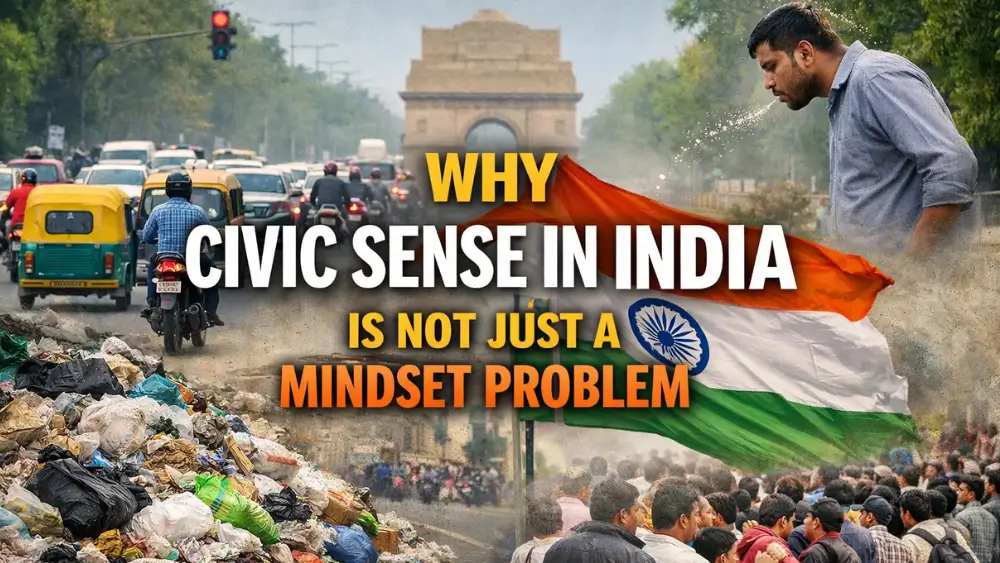
Civic sense in India is a topic that frequently sparks debate. From littered streets and chaotic traffic to public spitting and broken queues, many people quickly conclude that Indians simply lack civic sense.
But is the issue really that simple?
The reality is far more complex. Civic behavior is not shaped by mindset alone. It is influenced by systems, infrastructure, enforcement, and collective social norms. Blaming individuals without examining these deeper factors oversimplifies the problem.
Let’s take a closer look.
What Is Civic Sense?
Civic sense refers to responsible behavior in public spaces. It includes actions such as:
- Avoiding littering
- Following traffic rules
- Respecting queues
- Keeping public areas clean
- Protecting public property
At first glance, it may seem like a matter of basic manners or discipline. However, civic sense is deeply connected to how societies function.
The Common Misconception
A popular belief is that poor civic behavior is purely a “mindset problem.” Many argue that people are careless, irresponsible, or indifferent.
While individual responsibility matters, this explanation ignores several important factors:
- Availability of public infrastructure
- Strength of rule enforcement
- Cultural and social expectations
- Governance and accountability
If civic sense were only about mindset, then education and wealth would automatically guarantee responsible behavior. But in reality, even educated and financially stable individuals sometimes ignore public responsibilities.
This suggests the issue goes beyond personal awareness.
The Role of Systems and Infrastructure
Civic behavior improves when systems make responsible actions easy and irresponsible actions difficult.
Consider these examples:
- If garbage bins are not easily accessible, littering becomes more common.
- If traffic rules are rarely enforced, violations increase.
- If public toilets are insufficient, hygiene issues rise.
Strong systems create an environment where responsible behavior becomes the norm. Weak systems allow disorder to become routine.
When infrastructure and enforcement are consistent, civic sense naturally strengthens.
Social Norms Shape Behavior
Human beings are influenced by their surroundings. When people see others breaking rules without consequences, they are more likely to do the same.
This creates a cycle:
- Some individuals ignore rules.
- There is little or no enforcement.
- Others follow the same behavior.
- The behavior becomes socially accepted.
Over time, what was once considered wrong starts to feel normal.
Improving civic sense requires changing these social norms and creating a culture where responsible behavior is respected and expected.
Awareness Is Not the Same as Action
Many people know that littering, spitting, or breaking traffic rules is wrong. The issue is not always lack of knowledge.
The real challenge lies in:
- Inconsistent rule enforcement
- Limited accountability
- Weak public trust in systems
- A belief that “one person’s effort won’t make a difference”
When people feel that systems are ineffective, motivation to act responsibly declines.
The Real Issue Behind Civic Sense in India
The problem is not simply that citizens lack discipline. Instead, it involves a combination of factors:
- Weak institutional enforcement
- Gaps in infrastructure
- Social normalization of rule-breaking
- Low collective accountability
- Inconsistent governance
Civic sense is shaped by the environment people live in. When systems support responsible behavior, society gradually adapts.
How Can Civic Sense Be Improved?
Improving civic sense in India requires a balanced approach.
1. Strong and Fair Enforcement
Rules must apply equally to everyone without exceptions.
2. Better Public Infrastructure
Accessible garbage disposal, clean public toilets, and organized public transport systems encourage responsible behavior.
3. Cultural Shift
Society must promote and appreciate responsible actions while discouraging violations.
4. Individual Accountability
Citizens must lead by example and recognize their role in shaping public spaces.
Conclusion
Civic sense in India is not merely a mindset issue. It is a reflection of systems, social norms, infrastructure, and governance.
Blaming individuals alone will not create lasting change. Real progress requires both institutional reform and personal responsibility.
Instead of asking, “Why don’t people behave properly?”
Perhaps the more important question is:
What kind of systems and social expectations are shaping public behavior?
When both citizens and institutions work together, meaningful improvement becomes possible.