
Table of Contents
For decades, the cornerstone of digital identity has been a secret known only to you: the password. From our first email accounts to our online banking, we’ve been taught to create complex, unique passwords and to change them regularly. Yet, this decades-old paradigm is crumbling. We are drowning in a sea of passwords, and the digital shores are littered with the wreckage of data breaches caused by their failure. The search for a solution has converged on a single, powerful answer: passwordless authentication. But is this merely a convenient trend, or is it the inevitable future of security?
The evidence is overwhelming. A recent report from the FIDO Alliance indicates that 87% of companies are either actively deploying or planning to deploy passkeys, the leading form of passwordless authentication. This isn’t a tentative experiment; it’s a full-scale industry shift. As we move through 2026, the transition away from the vulnerable “what you know” model to a more secure “who you are and what you have” model is accelerating, driven by escalating cyber threats and a demand for seamless user experiences. This article explores the demise of the password, the rise of its replacement, and why this transformation is fundamental to our digital future.
The Inevitable Demise of the Password
To understand why the industry is moving passwordless, we must first diagnose the fatal flaws of the traditional password.
The Human Factor: Weakness and Reuse
The fundamental problem with passwords lies in human psychology. Faced with the need to remember dozens, if not hundreds, of credentials, users understandably take shortcuts. They create simple, predictable passwords (123456, password, qwerty remain perennially popular) and, most critically, they reuse them across multiple sites. A breach of a minor social media site can thus provide attackers with the keys to a user’s email, banking, and corporate networks. This “credential stuffing” is a primary attack vector, accounting for billions of fraudulent login attempts daily.
The Phishing Epidemic
Even the strongest password is useless if a user can be tricked into handing it over. Phishing attacks, where attackers masquerade as legitimate entities to steal credentials, have become increasingly sophisticated, often leveraging AI to create highly convincing fake emails and websites. According to cybersecurity reports, four of the five top data breaches in 2024 were due to stolen credentials, many acquired through phishing. The password system inherently trains users to perform an unsafe action: typing their secret into a web page, with no innate way to verify its legitimacy.
The Crushing Administrative Burden
For organizations, the password problem isn’t just a security risk; it’s a massive operational expense. IT help desks report that 30-50% of all their tickets are for password resets. This represents a significant drain on resources, productivity loss for employees, and frustration for users. The cost of managing a password-based system—from enforcement software to support staff—adds up to a substantial sum that offers diminishing returns in security.
What is Passwordless Authentication?
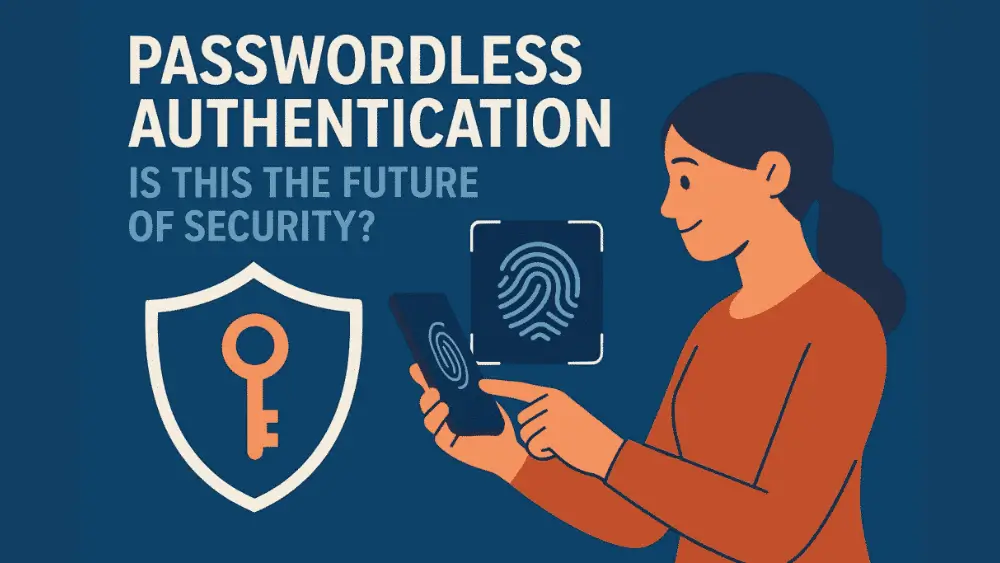
Passwordless authentication is a method of verifying a user’s identity without requiring them to input a memorized secret (a password). Instead, it relies on one or a combination of the following factors:
- Something You Are: Biometrics (fingerprint, facial recognition, iris scan).
- Something You Have: A registered device like your smartphone, a hardware security key, or a secure authenticator app.
- Something You Know: This can remain, but not as a password. It could be a PIN local to your device, which never gets transmitted over the network.
The core principle is that the authentication secret never leaves the user’s personal device. This stands in stark contrast to passwords, which are transmitted to and stored on a server, creating a valuable target for hackers.
The Gold Standard: FIDO and the Magic of Public-Key Cryptography
The most secure and promising passwordless technologies are built on the FIDO2 (Fast IDentity Online) set of standards. FIDO2 utilizes public-key cryptography, the same technology that secures HTTPS connections, to provide phishing-resistant logins.
Here’s a simplified breakdown of how it works:
- Registration: When you create an account on a website that supports FIDO2, your device (e.g., your phone or laptop) generates a unique cryptographic key pair: a private key and a public key.
- Device Binding: The private key is stored securely—and never leaves—your device, often in a dedicated hardware security chip called a Trusted Platform Module (TPM). The public key is sent to the website’s server and associated with your account.
- Authentication: When you next log in, the website sends a “challenge” to your device. Your device must sign this challenge with your private key to prove ownership.
- Unlocking the Private Key: To use the private key, you must first unlock your device using a biometric sensor (fingerprint or face) or a device PIN. This step seamlessly combines “something you have” (the device) with “something you are” (your biometric) or “something you know” (your PIN).
- Verification: The signed challenge is sent back to the website, which verifies it using your stored public key. If the signature is valid, you are granted access.
The critical security advantage is that the private key never leaves your device and is useless without the physical possession of that device and your biometric. A hacker on the other side of the world cannot phish it, and it is immune to data breaches on the server because the server only holds the public key, which is, by design, not a secret.
The Driving Forces: Why the Shift is Happening Now
The technology for passwordless authentication has existed for years. However, several converging factors have pushed it into the mainstream.
1. The Escalating Cyber Threat Landscape
The cost and frequency of cyberattacks are at an all-time high. With the advent of AI-powered phishing and automated credential-stuffing tools, the weaknesses of passwords are being exploited at an industrial scale. Organizations can no longer tolerate a security control that is so easily bypassed. Moving to phishing-resistant FIDO-based authentication is increasingly seen as a non-negotiable security upgrade.
2. The User Experience (UX) Imperative
In a competitive digital economy, friction is the enemy of conversion. Users abandon carts and fail to sign up for services when faced with the tedious process of creating and remembering yet another password. Passwordless authentication transforms this experience. Logging in becomes as simple as looking at your phone or tapping a security key—actions that take a second and require no memorization. This seamless experience boosts user satisfaction, productivity, and ultimately, a company’s bottom line.
3. Regulatory Push and Industry Consensus
Global regulations like GDPR in Europe and security frameworks like NIST’s guidelines in the U.S. are increasingly advocating for stronger, multi-factor authentication. Furthermore, the tech industry’s biggest players—Apple, Google, and Microsoft—have thrown their collective weight behind the FIDO standard. All three now natively support passkeys (a user-friendly form of FIDO credentials) across their major operating systems and browsers. This unprecedented collaboration has created the critical mass needed for widespread adoption.
A Closer Look at the Methods
While all passwordless methods aim to eliminate the password, they do so in different ways, with varying levels of security and convenience.
| Method | How It Works | Pros & Cons |
|---|---|---|
| Passkeys (Biometrics) | The most user-friendly method. A FIDO credential stored on your device (phone, laptop) and unlocked with a fingerprint or face scan. | Pros: Extremely user-friendly, phishing-resistant, seamlessly integrated into modern devices. Cons: Tied to a device ecosystem; recovery process is critical. |
| Hardware Security Keys | A physical device (e.g., a YubiKey) that you plug into a USB port or connect via NFC. You press a button on the key to authenticate. | Pros: The highest level of security, excellent for protecting highly sensitive accounts, completely immune to phishing. Cons: Can be lost or stolen, requires carrying an extra item, additional cost. |
| One-Time Passwords (OTP) | A temporary code sent via SMS, email, or generated by an authenticator app (like Google Authenticator or Authy). | Pros: Familiar to users, easy to implement, better than a password alone. Cons: SMS-based OTP is vulnerable to SIM-swapping attacks. App-based OTPs are more secure but still vulnerable to real-time phishing. |
Weighing the Scale: Benefits and Challenges of Adoption
The case for passwordless is strong, but the transition is not without its hurdles.
The Compelling Benefits
- Dramatically Enhanced Security: By eliminating passwords, you remove the primary vector for account takeover attacks. Companies like Accenture have reported a 60% drop in phishing attacks after implementing passwordless solutions. The shift to phishing-resistant public-key cryptography represents a quantum leap in security posture.
- A Revolution in User Experience: The login process becomes faster, easier, and frictionless. This leads to higher conversion rates for businesses, reduced frustration for customers, and less downtime for employees. It removes the cognitive load of password management from the end-user.
- Significant Cost Reduction: By drastically reducing the volume of password-related help desk tickets, organizations can reallocate IT resources to more strategic initiatives. The Return on Investment (ROI) is often clear and compelling, making the business case easy to justify.
The Real-World Challenges
- Integration with Legacy Systems: Many large organizations run on a patchwork of old and new applications. Retrofitting passwordless authentication into a 20-year-old legacy system can be a complex, time-consuming, and expensive engineering challenge.
- User Resistance and Education: While the end-state is simpler, the initial transition can be confusing. Users are habituated to passwords and may distrust new methods, especially those involving biometrics. A clear communication and education strategy is essential for successful adoption.
- Initial Investment and Implementation: There are upfront costs associated with purchasing new technology, licensing software from identity providers, and dedicating internal resources to manage the rollout. For some, this initial investment can be a barrier.
The Future Outlook: Beyond the Password
The move to passwordless is not the end of the road; it is the foundation for the next generation of digital identity. Several emerging technologies will build upon this foundation.
1. AI-Powered Adaptive Authentication
The future of security is context-aware. Adaptive authentication uses artificial intelligence to analyze a myriad of data points in real-time—your typical login location, the device you’re using, your network, and even behavioral biometrics like keystroke dynamics and mouse movements. The system continuously calculates a risk score. If you log in from your usual coffee shop with your phone, you might get seamless access. But if a login attempt comes from a new country on a strange device, the system will require step-up authentication, all invisibly to the user. This creates a security model that is both robust and minimally intrusive.
2. Decentralized Identity (DID)
This paradigm shift, often built on blockchain-like technology, aims to give individuals full control over their digital identities. Instead of having your identity attributes (age, citizenship, qualifications) stored in a company’s database, you would hold them in a personal “digital wallet.” You could then present verifiable credentials to a service without revealing unnecessary personal data. Passwordless authentication would be the key that unlocks this wallet, creating a powerful and privacy-enhancing ecosystem.
3. The Quantum Question
While still on the horizon, the future advent of quantum computing poses a threat to current public-key cryptography. The cybersecurity industry is already researching and developing “post-quantum” cryptographic algorithms. The good news is that the agile, standards-based nature of the FIDO Alliance and similar bodies means that these new algorithms can be integrated into the passwordless framework, ensuring its longevity in a post-quantum world.
Conclusion: An Inevitable and Necessary Future
The evidence is clear and compelling. Passwordless authentication is not a speculative future; it is the inevitable future. The vulnerabilities of the password-based system are too great, and the benefits of its replacement—enhanced security, a seamless user experience, and reduced costs—are too significant to ignore.
The industry-wide momentum, led by tech giants and embraced by security-conscious enterprises, has created a tipping point. The question is no longer if we will move to a passwordless world, but how quickly we can get there. While challenges around legacy systems and user adoption remain, they are hurdles to be overcome, not reasons to turn back.
The transition from “what you know” to “who you are and what you have” represents the most fundamental improvement in digital security in a generation. It is a future where our digital identities are bound securely to our physical selves, making the internet a safer place to work, bank, shop, and connect. The journey beyond the password has begun, and it leads to a more secure and user-friendly horizon for everyone.